Why I Built MovingBox
As we approach the 1-year anniversary of the MovingBox launch, I thought I’d take a little time to reflect on the journey, and why I decided to build MovingBox in the first place.
The world has always been an uncertain place, and it seems like these days it’s even more so.
Having an accurate record of what you own in the wake of a disaster can help give you at least a sliver of peace of mind: the confidence that if something happens to your physical world, your insurance company can’t stiff you on top of it. You already pay for insurance, so you might as well make the most of it. MovingBox helps with that.
The Problem
Home inventory apps aren’t anything new.
In the spring of 2014 as I was preparing to move into my first apartment after college, I secured my renter’s insurance and began packing my things. As a musician and aspiring professional audio engineer, I had accumulated a fair number of musical instruments and other pieces of audio equipment, and decided this would be the perfect time to catalog everything for insurance.
I downloaded the only home inventory app I could find on the Mac App Store and started my journey. The app did a great job of cataloging my belongings, however the process was excruciating. I spent an entire weekend typing out the serial numbers of each individual piece of equipment, photographing each item from multiple angles, searching for URLs, and estimating replacement values. I barely made it halfway through before I gave up.
Fast forward a few years. I just purchased my first home, and had a renewed sense of motivation to finally finish my home inventory. My collection of instruments and gear had only grown, and the project looming in front of me was much larger. There was another app that had hit the scene that looked a little more intuitive: SaaS with a nice mobile app for rapid entry, barcode scanning to automatically populate details from the web, and allowed me to collaborate with my wife on the project. $2/month for the rest of eternity seemed like a fair price to pay. After a few weeks, this project fizzled out too. The company eventually made a pivot to business inventory and I lost all my data anyway.
I knew then that something needed to change. Beyond the time investment, there was another problem. Having detailed information about your possessions and their value locked away in some company’s servers, instead of in your personal, private iCloud account, is a liability.
Building the Solution
Fast forward again, to mid 2024. OpenAI had just added vision capabilities to GPT-4 and I had been playing around with a self-hosted home inventory app called HomeBox.
I was also getting more serious about learning SwiftUI, and decided that a mobile (iOS) client for HomeBox that could also speed up my inventory project by using AI to do the heavy lifting sounded like a great idea. After a few weeks I had a working prototype.
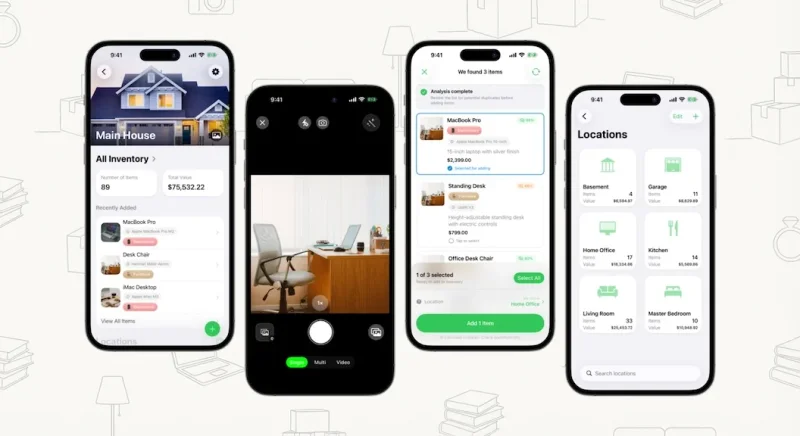
The first time I took a photo of an item on my desk and MovingBox instantly figured out the category, make, model, condition, extracted the serial number (which was barely visible) and parsed it all into a structured list, I knew that home inventory was now a solved problem.
Getting it to the App Store
After an intense few months of turning a prototype into a product, MovingBox hit the App Store in late April (about a week before my second daughter was born)! I’m incredibly grateful that the first release, and every release since then, has made it through App Review promptly and unscathed.
The past year has been a whirlwind, and I’ve almost achieved my original vision for the app. MovingBox can now catalog an entire room from a single video walkthrough, extract the items, crop the frames into photos (with various angles) and build a structured list of everything it sees – ready to export as a CSV to send to your insurance agent in the event something happens. And there’s a lot more coming.
What’s Next
I have no plans to slow down on MovingBox development, and I’m working (probably a little too much!) to keep delivering value to my users. WWDC is always on the horizon, and I plan to take full advantage of any new Apple technologies that will benefit MovingBox users.
My goal to build the best possible home inventory experience for Apple platforms is unchanged, but now that I’ve built a fairly robust offering I’m shifting my focus to sharing the benefits a home inventory can offer, and how MovingBox can help with that project.
If you’ve been on the fence about building a home inventory, and were initially put off by the massive time investment that was traditionally required, I’d be honored if you’d give MovingBox a try. If there’s something that’s missing or could be better, don’t hesitate to reach out directly at camden@movingbox.ai or submit a feature request in the app.